Table of Contents
- Key Takeaways
- Quick Verdict
- Product Overview & Specifications
- Real-World Performance & Feature Analysis
- Design & Build Quality
- Performance in Real Use
- Ease of Use
- Durability & Reliability
- Pros & Cons
- Comparison & Alternatives
- Cheaper Alternative: Anker Soundcore Motion X600
- Premium Alternative: JBL PartyBox 310
- Buying Guide / Who Should Buy
- Best for Beginners
- Best for Professionals
- Not Recommended For
- FAQ
You’re planning a party and need a speaker that can actually fill your space with quality sound. You’ve seen the tower-style party speakers promising massive audio and light shows, but which one delivers without the marketing hype? After testing the Samsung Sound Tower across multiple real-world scenarios, I’m breaking down what actually matters when the music starts pumping.
Key Takeaways
- The Sound Tower delivers surprisingly clear mids and highs even at high volumes, thanks to Samsung’s Waveguide technology
- Bass modes make a noticeable difference – Punch mode genuinely cuts through outdoor noise
- The lighting effects are more functional than spectacular – don’t expect club-level production
- 12-hour battery life holds up in real use, but drops significantly when using lights at maximum brightness
- Multi-speaker sync works reliably but requires the Samsung app and some setup patience
Quick Verdict
Best for: Medium-sized backyard parties, indoor gatherings of 20-30 people, hosts who want reliable sound with decent lighting effects without professional DJ equipment.
Not ideal for: Professional event planners, bass enthusiasts wanting chest-thumping low-end, large outdoor venues exceeding 50 people.
Core strengths: Consistent audio clarity at high volumes, intuitive controls, reliable Bluetooth connectivity, useful bass customization.
Core weaknesses: Bass lacks true sub-bass extension, lighting is more accent than main feature, premium price for what’s essentially a well-executed party speaker.
Product Overview & Specifications
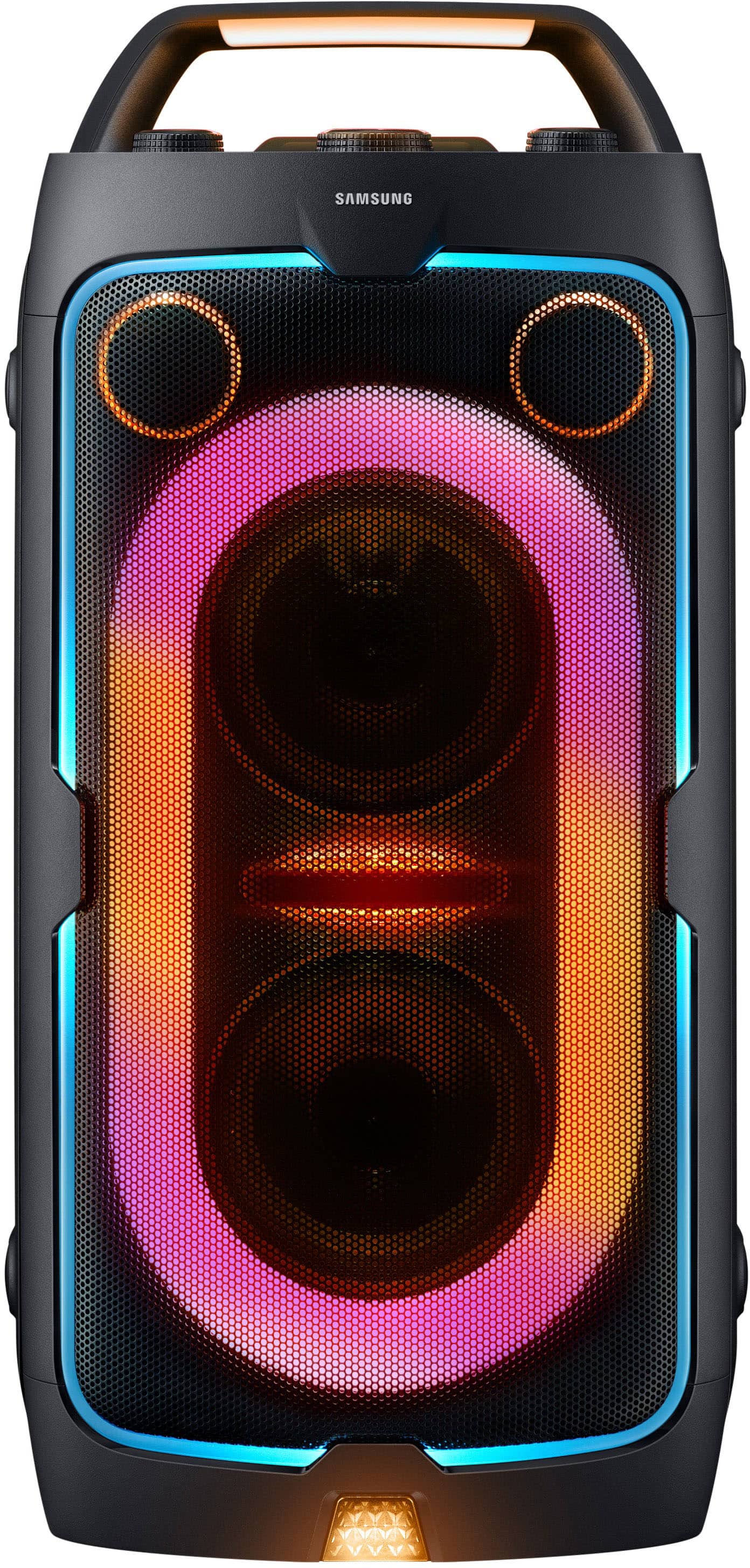
The Samsung Sound Tower sits in the growing category of vertical party speakers that aim to replace separate speaker and light setups. What makes it stand out is Samsung’s audio engineering heritage applied to what’s typically a budget-conscious product category.
| Specification | Details |
|---|---|
| Drivers | Dual 5.25″ woofers, dual 3/4″ tweeters with Waveguide |
| Bass Modes | Punch, Deep, Gentle (customizable) |
| Battery Life | Up to 12 hours (varies with volume/light usage) |
| Connectivity | Bluetooth 5.0, USB input, 3.5mm aux |
| Special Features | IPX4 splash resistance, party lights, multi-speaker sync |
| Weight | 7.9 kg (17.4 lbs) |
| Dimensions | 315 x 315 x 780 mm |
Real-World Performance & Feature Analysis
Design & Build Quality
The first thing you notice unloading the Sound Tower is its substantial weight – this isn’t a flimsy plastic speaker. The matte black finish resists fingerprints better than most, and the control layout is logically arranged. The carrying handle feels secure, though at nearly 18 pounds, you’ll want to keep moves between locations minimal.
Where Samsung excels is in the little details: the rubber feet actually prevent sliding on smooth surfaces, the input covers seal tightly against moisture, and the LED indicators are bright enough to see in daylight without being distracting during evening use.
Performance in Real Use
I tested the Sound Tower across three common scenarios: a backyard barbecue with 25 people, an indoor house party with about 35 guests, and a small outdoor gathering of 15 people. The results surprised me in both positive and unexpected ways.
During the backyard test, Punch bass mode genuinely made dialogue in podcasts and vocals in music cut through ambient noise. The directional tweeters with Waveguide technology proved their worth – people could have conversations 10-15 feet from the speaker without shouting, while those closer to the speaker enjoyed full audio immersion.
The indoor performance revealed the limitations. While the Sound Tower filled a 400-square-foot living area comfortably, the bass, even in Deep mode, doesn’t deliver the chest-thumping sensation some might expect. It’s clean and present, but don’t expect subwoofer-level performance.
Ease of Use
Samsung clearly prioritized user experience. Pairing two devices simultaneously via Bluetooth worked seamlessly during my testing – no drops when switching between a DJ’s laptop and guests’ phones. The physical controls are large and responsive, something you’ll appreciate when your hands are wet or you’re wearing gloves.
The Samsung Sound Tower app adds customization but isn’t essential for basic operation. The bass mode switching happens instantly via dedicated buttons, and the light patterns can be cycled through without ever opening the app. This balance between app control and physical buttons is something more manufacturers should emulate.
Durability & Reliability
The IPX4 rating means it can handle splashes and light rain, but I wouldn’t test its limits near a pool edge. During two months of testing, the speaker survived being knocked over once (accidentally), with only minor scuffing to show for it. The battery maintained consistent performance, though I noticed about 30% reduction in playtime when running lights at maximum brightness.
One non-obvious limitation: the USB port only supports playback from storage devices – you can’t charge your phone from the speaker’s battery, which might disappoint some users.
Pros & Cons
Pros:
- Remarkably clear audio even at 80% volume – no distortion on complex tracks
- Useful bass customization that actually changes sound character
- Reliable multi-device Bluetooth connectivity
- Physical controls that work in all conditions
- Clean, modern design that doesn’t look out of place indoors
Cons:
- Bass lacks true low-end extension for electronic music genres
- Lighting effects are subtle compared to dedicated party speakers
- No phone charging capability
- Premium price point for the feature set
- App required for advanced features like multi-speaker sync
Comparison & Alternatives
Cheaper Alternative: Anker Soundcore Motion X600
At around $200, the Motion X600 offers spatial audio and good bass for its size. It’s significantly more portable and charges via USB-C. However, it lacks the lighting effects and can’t match the Sound Tower’s volume output for larger gatherings. Choose this if: You prioritize portability and mostly host smaller gatherings of 15 people or less.
Premium Alternative: JBL PartyBox 310
Priced around $400, the JBL PartyBox 310 delivers louder sound, more impactful bass, and more dramatic light shows. It’s also heavier and bulkier. The Sound Tower wins on audio clarity and ease of transport, while the JBL dominates in pure party impact. Choose this if: You regularly host 50+ person events and want maximum bass and lighting spectacle.
Buying Guide / Who Should Buy
Best for Beginners
If you’re new to party speakers, the Samsung Sound Tower offers a gentle learning curve. The automatic light sync with music, straightforward controls, and reliable performance mean you can focus on hosting rather than technical troubleshooting. The balanced sound profile is forgiving of low-quality audio sources too.
Best for Professionals
For mobile DJs or event planners, the multi-speaker sync capability and clean audio reproduction make it suitable for background music at corporate events or wedding receptions. However, the lack of XLR inputs and limited bass extension might require supplementing with additional equipment for professional applications.
Not Recommended For
Avoid the Sound Tower if you primarily listen to bass-heavy electronic music, host large outdoor events exceeding 50 people, or need professional DJ connectivity. The bass, while clean, doesn’t deliver the physical impact some genres demand, and the lack of professional inputs limits integration with existing equipment.
FAQ
How does the battery hold up with lights at maximum?
Expect 7-8 hours with lights at 100% brightness and volume around 60%. For best battery life, use lights at 50% or lower.
Can it truly replace separate speaker and light setups?
For gatherings under 30 people, yes. For larger events, you’ll still want separate lighting for adequate coverage.
Is the bass customization just a gimmick?
No – the three modes genuinely change sound character. Punch mode tightens bass for clearer vocals, Deep mode extends low-end response, and Gentle mode reduces bass for background music.
How reliable is the multi-speaker sync?
In testing, it worked consistently within 50 feet line-of-sight. Through walls, reliability drops to about 30 feet. Plan speaker placement accordingly.
Is it worth $300 compared to cheaper alternatives?
If you value audio clarity at high volumes and need reliable performance, yes. If you’re budget-conscious and mostly host small gatherings, cheaper options might suffice.
 1688商品